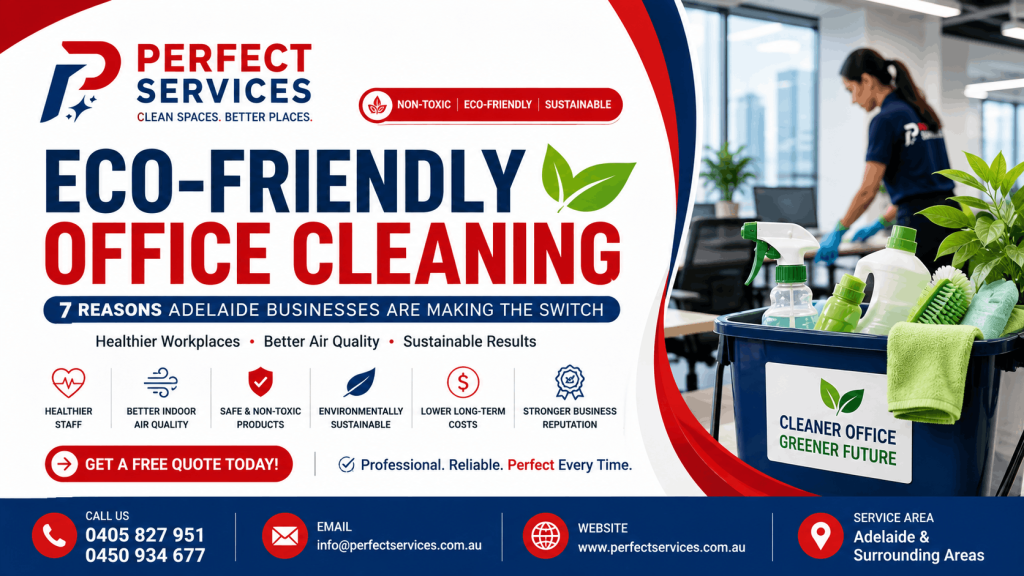
Most Adelaide businesses don’t move to eco-friendly office cleaning because of a sustainability policy. They move because a meeting room still smells of solvent at 8:30 on a Monday, or a staff member with asthma raises it, or a landlord adds an environmental clause at lease renewal.
Then the search begins, and it hits a wall. Nearly every commercial cleaner in South Australia now advertises green products. Very few can name which ones or produce a certificate.
This guide covers what eco-friendly office cleaning in Adelaide actually involves, what the evidence supports, what it costs, and the five questions that separate a real low-tox program from a bottle with a leaf on the label.
What eco-friendly office cleaning actually means
It’s a system, not a product swap. A provider running eco-friendly office cleaning properly has changed four things.
Chemistry. Independently certified, biodegradable, low-VOC products replacing solvent-heavy and chlorine-based cleaners.
Method. Color-coded microfiber and flat-mop systems that lift soil mechanically, so less chemical is needed at all. Wiping and pouring rather than spraying, because aerosolized droplets are the delivery route most strongly linked to respiratory harm.
Dosing. Concentrates diluted through a metered wall unit instead of free-poured. This is where most green programs quietly fail an over-dosed eco product is still an over-dosed product.
Training. Cleaners who understand contact times and correct application, plus refillable containers and controlled water use.
If a provider has only changed the first item, they’ve changed suppliers, not their cleaning.
The certification test
“Natural,” “green” and “eco” have no legal definition in Australia. Certification does.
Good Environmental Choice Australia (GECA) is the country’s independent, not-for-profit ecolabel, operating under ISO 14024 the strictest tier of environmental labelling. Its cleaning products standard assesses the whole lifecycle: ingredient toxicity, biodegradability, aquatic impact, manufacturing conditions and disposal. Standards are reviewed every four years and certification can be withdrawn.
For tenants in rated buildings, the Green Building Council of Australia’s Green Star framework assesses indoor environmental quality as part of operational performance which is why certified cleaning increasingly appears as a written lease requirement rather than an optional extra.
Ask any provider for the certificate number. A real one is checkable in a minute.
What the evidence supports and what it doesn’t
A 2020 meta-analysis found occupational exposure to cleaning products associated with roughly a 50% higher risk of asthma and a 43% higher risk of chronic obstructive pulmonary disease. The American Lung Association links the volatile organic compounds released during cleaning to chronic respiratory problems, allergic reactions and headaches, with sprays and disinfectants showing the strongest associations.
The exposure outlasts the shift, too. Controlled testing of common cleaning tasks found VOCs still airborne after the task ended, meaning anyone entering the room shortly afterwards is still breathing them. For an office cleaned overnight, that’s your staff walking in at eight.
One finding cuts against the industry’s own marketing. When researchers tested 30 cleaning products in 2023, they detected 530 distinct VOCs, 193 classified as hazardous across both conventional products and self-described “green” ones. The label predicted almost nothing. Certification and formulation did.
Being straight about the limits: the strongest evidence concerns cleaners themselves, who handle these products at close range every shift. Office occupants are a lower-exposure group, and nobody can honestly promise your absence rate will fall by a set figure. What eco-friendly office cleaning reliably delivers is a lower chemical load and less residual odor, with the biggest benefit going to the people doing the work. Safe Work Australia’s guidance on hazardous chemicals sets out your own obligations, including the safety data sheets your provider should supply on request.
Does eco-friendly office cleaning cost more?
The products cost more per liter. The contract usually doesn’t.
Certified concentrates carry a higher unit price than bulk conventional chemicals. What pulls the total back down is that metered dilution uses a fraction of the volume of ready-to-use product, multi-surface certified cleaners collapse four or five products into one, and microfiber systems cut chemical use per clean. Gentler chemistry also extends the life of carpets, floor seals and timber finishes which is where low-toxicity carpet cleaning pays for itself.
For a typical Adelaide office, a fully certified program lands within a few percent of a conventional one. Frequency and scope move the price far more than chemistry does.
The question to ask every provider: are green products included as standard, or billed as an upgrade? A cheaper headline rate with a surcharge attached often finishes higher. Our guide to comparing cleaning quotes covers the other line items that differ between quotes looking identical up front.
5 questions that expose greenwashing
The ACCC has made environmental claims an enforcement priority, publishing eight principles for businesses after a sweep in which more than half the businesses reviewed made claims the regulator considered concerning. Vague eco claims can breach the Australian Consumer Law — and if you repeat your cleaner’s claims in your own reporting, that exposure becomes partly yours.
- Which certification, and what’s the certificate number? “Plant-based” and “manufacturer-tested” are not certifications.
- Standard or add-on? Get it written on the quote, not said in the meeting.
- How is product diluted? Metered dispensing or free-pouring. This reveals more than any other question whether the program is real.
- Are cleaners trained on contact times? Certified disinfectant applied wrongly is expensive water.
- Can you supply safety data sheets for everything used on site? A genuine provider has these ready within the hour, not the week.
For the non-environmental criteria, see our guide to choosing an office cleaning company in Adelaide.
How we run eco-friendly office cleaning in Adelaide
We’ve spent over seven years cleaning Adelaide workplaces offices, schools, childcare centers and warehouses. Childcare taught us most of what we now apply to offices, because the tolerance for chemical residue in a room full of toddlers is close to zero.
Every engagement starts with a walkthrough covering surfaces, ventilation, occupancy hours and any existing sensitivities among your staff. You then get a written product schedule listing what will be used where, with certifications and safety data sheets attached, before anything is signed. From there: a schedule built around your occupancy, the same team each visit so application stays consistent, and a 24-hour re-clean if something’s missed.
We cover Adelaide CBD, North Adelaide, Norwood, Unley, Prospect, Burnside, Mawson Lakes, Modbury, Regency Park and West Lakes. Single sites run through our office cleaning service; multi-site portfolios through commercial cleaning.
Frequently asked questions
Is eco-friendly office cleaning as effective as conventional chemicals? For surfaces, floors, glass and washrooms, certified products meet commercial-grade performance standards, and the gap that existed a decade ago has largely closed. For outbreak response, a targeted registered disinfectant may still be appropriate applied to cloth, not sprayed.
What certification should I look for in Australia? GECA is the benchmark: independent, not-for-profit, ISO 14024, assessed across the full lifecycle. Verify the certificate number on the GECA register rather than taking the claim on trust.
Will eco-friendly office cleaning reduce our sick days? Possibly, but no provider can honestly promise a number. The reliable outcomes are reduced VOC exposure and less residual odor. Absence rates depend on ventilation, cleaning frequency and much else outside any cleaning contract.
Can green cleaning help staff with allergies or asthma? Fragrance-free, low-VOC products reduce the risk of triggering irritation in shared spaces, and avoiding spray application reduces it further. Flag diagnosed sensitivities at the walkthrough it changes the product schedule.
Get a quote for eco-friendly office cleaning in Adelaide
Switching doesn’t mean compromising on how the office looks on Monday morning. It means knowing what’s being used in your workplace and being able to check it.
We’ll give you the full product schedule and certifications up front, before you commit to anything. Request a free, no-obligation quote or call (04) 0582 7951. Site walkthroughs across metropolitan Adelaide, usually within two business days.