
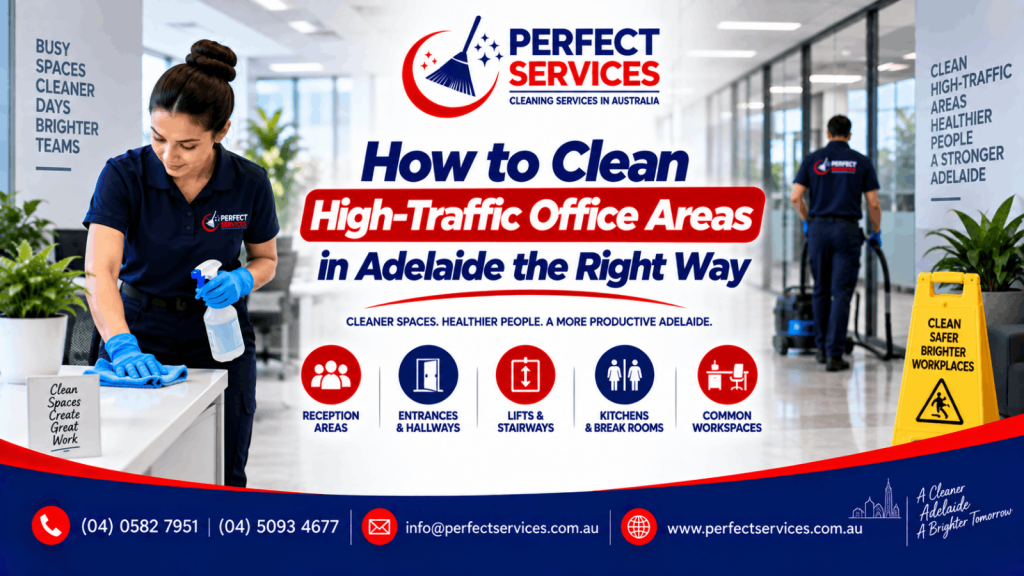
There is a specific moment in any office where you stop noticing the corridor. You walked down it a hundred times and it looks fine, so your brain stops registering it. Then a visitor walks in and within ten seconds they have formed an impression of your business based on a floor that has not been properly addressed in two weeks.
High-traffic areas are the parts of an Adelaide office that carry the most use and receive the most attention in theory, but the least thorough attention in practice. Here is how to actually clean high-traffic office areas in Adelaide the right way.
What Counts as a High-Traffic Area in an Adelaide Office
The obvious ones are entrance areas, main corridors and the path between the door and the most-used desks. But high-traffic in an office cleaning context means any surface that is touched or walked on by most of the occupants on most days.
That includes the kitchen benchtop and tap handles. The bathroom door handle. The button on the printer. The handrail on the stairs. The edge of the reception desk where people lean. These surfaces accumulate contamination faster than anywhere else in the building and are often not given proportionally more attention in a standard cleaning scope.
The surfaces that carry the highest contact contamination load in most Adelaide offices are not the floors. They are the contact points at hand height.
Why Standard Cleaning Does Not Work on High-Traffic Areas
A standard mop-and-wipe routine is designed for maintenance cleaning of surfaces that have low to moderate use. It addresses what is visible and restores a baseline level of cleanliness.
High-traffic surfaces do not respond to baseline maintenance the same way. A corridor floor that is walked on by thirty people per hour accumulates grit that a standard mop cannot lift because the grit has been pressed into the surface texture. A door handle touched two hundred times per day between cleans has not just surface contamination. It has layered contact residue that a spray-and-wipe approach distributes rather than removes.
Cleaning high-traffic areas properly means understanding the mechanism of accumulation on each surface type and using the method that actually addresses it, not just the method that looks like it did.
How to Clean High-Traffic Floors in Adelaide Offices
Entrance areas
The entrance is where the contamination from outside enters the building. Adelaide’s mix of dry summer dust and winter wet means entry areas accumulate completely different material depending on the season.
An effective entrance clean starts with dry removal before any wet process. Vacuuming or dry mopping first removes the loose material. A wet mop applied to an entrance that has not been dry-cleaned first pushes the loose material into the surface rather than removing it.
Entrance matting that is not being lifted and cleaned underneath is one of the most common sources of persistent entry odor in Adelaide offices. The mat traps material on its surface and underneath. Cleaning the top of the mat while leaving the accumulation underneath produces diminishing returns quickly.
Corridors and main paths
Corridor floors need extraction-level attention more frequently than the rest of the office floor. In a carpeted Adelaide office, the main corridor path should be extracted quarterly at minimum, regardless of whether it looks like it needs it. By the time the traffic lane is visibly darker than the edges, the grit has been grinding into the fibres for months.
Our carpet cleaning service handles traffic lane extraction across Adelaide offices on a coordinated schedule with the regular office cleaning visits so the two services stay in sync.
Hard floors in corridors accumulate surface scratching from grit that is not being removed quickly enough. The correct sequence is sweep, vacuum edges, then mop with an appropriate cleaner for the floor type. A mop applied to an unvacuumed hard floor moves the grit around.
How to Clean High-Traffic Contact Surfaces in Adelaide Offices
This is the area where most Adelaide office cleaning scopes are weakest. Contact surfaces at hand height are touched more than any other surface in the building and are often either absent from the scope entirely or addressed with a wipe rather than a sanities.
Door handles need a product with a minimum contact time, not a wipe that distributes the surface contamination. Apply the product, allow it to sit for the contact time specified on the safety data sheet, then wipe. A ten-second wipe with a disinfectant spray does not achieve disinfection. It achieves the appearance of disinfection.
Light switches are touched by every person in the office every day and are cleaned in most offices approximately never. They should be on the inclusions list for every visit. If they are not on yours, add them.
Shared equipment surfaces including the printer, the coffee machine, shared phones and keyboards need to be part of the scope. They are not in most standard cleaning contracts.
According to Safe Work Australia, employers have a duty to maintain safe and sanitary working environments. Contact surface contamination is a primary mechanism for illness transmission in shared workspaces, and it is directly addressable through cleaning scope decisions.
The Frequency Question for High-Traffic Areas
The answer to how often high-traffic areas need cleaning is almost always more often than the rest of the office. That sounds obvious but it is rarely reflected in actual cleaning scopes, which tend to apply uniform frequency across the whole building.
A practical approach for Adelaide offices:
Entry areas and main corridors should be vacuumed or swept daily in any office with ten or more staff. A single weekly clean leaves four days of accumulation in the highest-use part of the building.
Contact surfaces at hand height should be sanitized on every cleaning visit, not every second visit or weekly.
Carpet extraction in traffic lanes should happen quarterly for offices with regular foot traffic. Annual extraction is appropriate for low-traffic carpeted areas.
What a Proper High-Traffic Clean Looks Like in Practice
We start at the entry and work systematically through the space, addressing contact surfaces first, then floors. Entry mat lifted, cleaned underneath, replaced. Entrance floor dry-cleaned then wet-mopped. Corridor vacuumed in the direction of traffic flow then cross-vacuumed. All door handles and light switches sanitized with correct contact time. Shared equipment surfaces included in the scope.
This takes longer than a standard clean of the same area. It also produces a result that actually addresses what accumulated since the last visit, rather than distributing it more evenly across the surface.
Our commercial cleaning service across Adelaide is built around this kind of specific approach to different area types within the same building. A single scope applied uniformly across a whole office does not serve high-traffic areas well.
Get in Touch
📞 0405 827 951 or 0450 934 677 📧 info@perfectservices.com.au
See our full services page for everything we provide across Adelaide.